
Why Columbia?
In many ways, the families who moved to Columbia were typical of other young homebuyers in the 1960s: they sought an affordable house with room to grow, proximity to their place of work, a decent school system, and other amenities. But these particular homebuyers found the plans for Columbia especially appealing. As Jewish pioneer resident Helane Jeffreys put it, “Columbia started with a vision, and the people who came were attracted to that vision.”
“The ideas of Jim Rouse were very, very beautiful. We both liked very much what he was saying, that it was going to be a liberally inclusive process. Also it was important that there were going to be a variety of amenities, sports, the pools, all of that.”
Shep Jeffreys
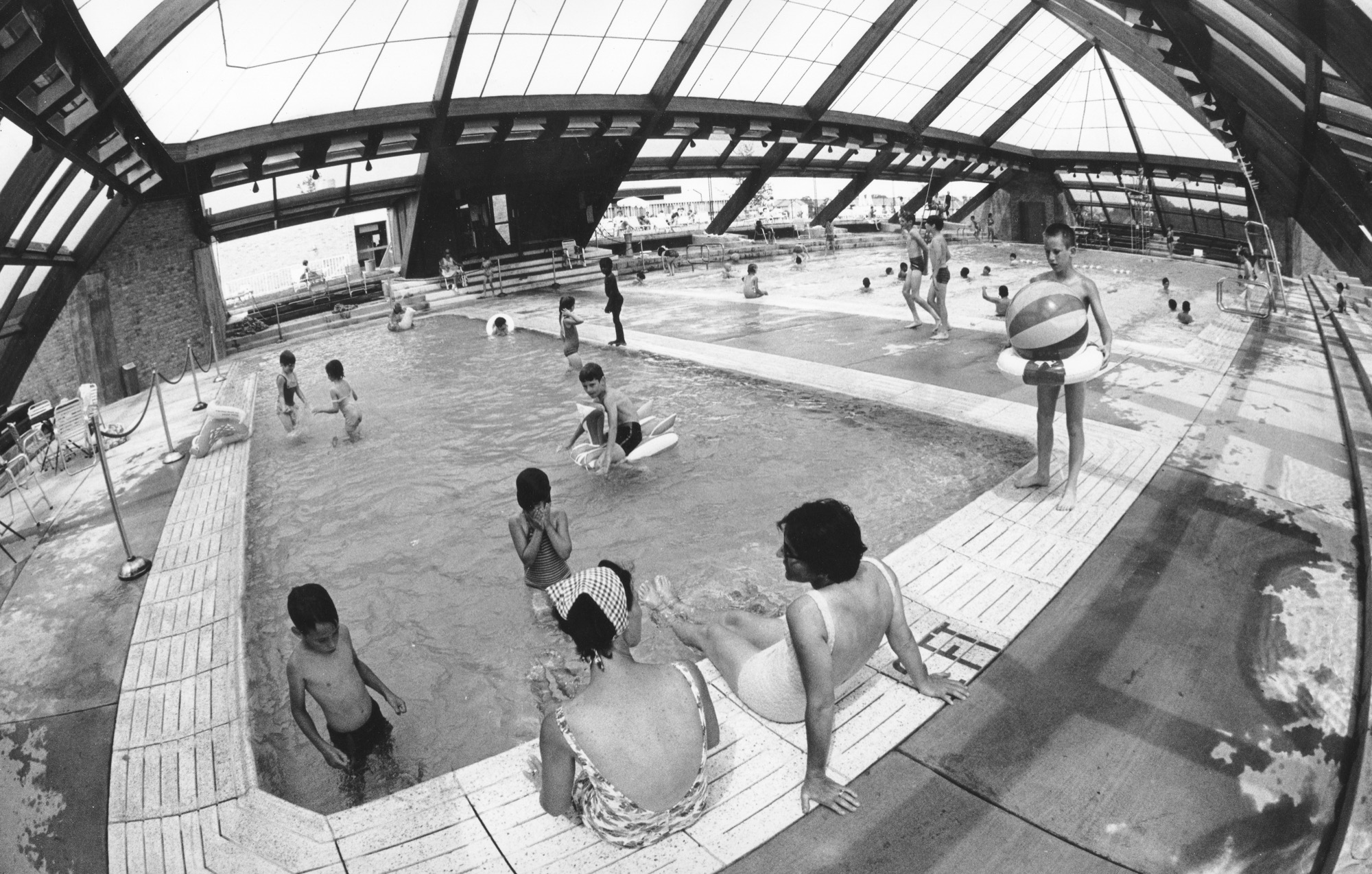
Wilde Lake Swim Center, 1969.
Courtesy of Columbia MD Archives, Photograph Collection
Choosing “The Next America”
Families who arrived in the first few years knew that Columbia differed from the thousands of other residential developments opening across America. Its marketing materials emphasized that it was a planned community, and highlighted everything from community centers to nature preserves to racial diversity.
“We knew Columbia was a planned community. I’m not sure we knew what that meant, but we very much wanted the ethnic diversity for our children.”
Lynne Warshaw

Columbia photographer (and Jewish pioneer) Fern Eisner combined two Columbia ideals in this photo, c. 1969: access to nature and racial diversity.
Courtesy of Columbia MD Archives, Photograph Collection
My parents were interested in a diverse community, an integrated community. That was a new concept. Columbia broke all the rules and a lot of barriers.
I loved that Columbia was going to be a place for all people.
My mom was drawn to the ideal of Columbia as an integrated community that embraced diversity.
My dad was a civil rights activist. One reason he moved there was because of the integration policy, both racially and economically. There was no place like that at the time in the U.S.

From a 1972 brochure.
Courtesy of Columbia MD Archives, Serials Collection
Two artist renderings showing what Columbia would look like once completed. When the first residents moved in, the city was still under construction.

Illustrations by Robert Tennenbaum, c. 1965, courtesy of Columbia MD Archives, Photograph Collection

We liked the idea of starting fresh in a place that was starting fresh.

Courtesy of Columbia MD Archives, Books and Studies Collection
This ad (left) shows homes for a variety of incomes; other ads advertised apartment living. Rather than touting exclusivity, Columbia touted its goal of economic diversity. From Columbia Today, June 1969.
One of my friends who had moved to Columbia sent us a couple of floor plans. We said well, these are affordable, and it would only take him an hour to get to work

Wes Yamaka poster belonging to CJC rabbi Martin Siegel. Courtesy of Martin Siegel
Early residents, Jewish and non-Jewish, tended to be like-minded people. Wes Yamaka was a Protestant minister, social justice advocate, and artist who arrived in 1968. His artwork embodied the values of his fellow Columbia pioneers.
You weren’t a true Columbian if you didn’t have a Wes Yamaka poster hanging in your house.

Wes Yamaka, “Shalom.” Courtesy of Columbia MD Archives, Posters and Original Artwork Collection
Columbia’s Jewish Pioneers
They came from New York and Baltimore, Philadelphia and Pittsburgh, and other places in the East and Midwest. They grew up as Orthodox, Conservative, Reform, and secular. They were teachers, doctors, federal government workers, lawyers, scientists, social workers, and more. Several were military veterans. Some came from families that had fled Nazi Germany or survived the Holocaust. Whatever their background, many of the Jews interested in contributing to Columbia also wanted to help create a place for Jewish life.

Courtesy of Suzanne Waller
Fern and Arie Eisner arrived in 1968. “We fell in love with Columbia and got involved in so many different things,” Arie later recalled. “We were young and adventurous.” Fern, a professional photographer, became heavily involved in Columbia’s arts and culture scene as well as the Women’s Center. Arie, a physicist from Israel, taught Hebrew in Columbia’s first Jewish school.
“The first wave of us were idealists.”
Jay Goldscher
Early Jewish Columbians (In Progress!)
Many early Jewish Columbians contributed their memories and pictures to this project. They are listed below. Would you like to be included on the list? Share your photos and memories with us!
- Irwin, Shirley and Susan Auerbach, 1967
- Helen and Marty Ruther, 1967
- Fern and Arie Eisner, 1968
- Bobbi and Marty Fagan, 1968
- Helane and Shep Jeffreys, 1968
- Phyllis and Bernard Nash, 1968
- Lynne and Martin Warshaw, 1968
- Chaya (Iris) and Gerson Kaplan, 1969
- Suzanne and Bob Waller, 1969
- Rita and Dick Goldberg, 1970
- Helene and Carl Segal, 1970
- Carol and Jeff Friedhoffer, 1971
- Janet Epstein (Filtzer) Brady, 1972
- Pearl and Tom Laufer, 1972
- Judith and Rabbi Martin Siegel, 1972
- Vicki and Rabbi Stephen Fuchs 1973-74
- Etarae and Jerry Weinstein, 1973
- Toby and Neville Brookes, 1974
Are you a member of a Jewish Columbia pioneer family that is not named here?
If you have names or photos for us to share on this site