
The Original Kids
Some called it the “Columbia Bubble.” Columbia’s children of the 1960s and 1970s found an idyllic setting: their schools were new and progressive, their streets and parks felt safe, and they were welcomed into the homes of all their friends, regardless of race or religion. Still, “the Jewish kids got to know each other right away,” remembers Neil Fagan. With their parents organizing congregations and Hebrew schools, “we were together a lot.”

These graduating seniors from the class of 1981 entered Columbia’s very first kindergarten class in 1968, at Bryant Woods Elementary. At least nine of the 32 graduates shown here are from the pioneer families of the Jewish community.
L-R, bottom row: Ron Jeffreys, Steve Tove, Andy Waller, Jonathan Rose, Ted Millison, Trae Smith, David Ruther, Stephen Frezza. Middle row: Chris Ott, Tim Storch, Sherri Evans, Natalie Rivers, Denise Jennings, Crystal Hruby, Robin Brodkin, Erin Reichle. Top row: Joan Lee-Powell, Tim Lea, David Bryant, Ann Tennenbaum, Becky Carlson, Hugh Lenzer, Clare Widitz, Denise Rowe, David Kline, Susan Bohandy, Beth Gallagher, David Fagan, Ann Hallendorff, Susan Harris, Ann Chambers, Alice Flack.
Photo by Fern Eisner, courtesy of Columbia MD Archives, Photograph Collection
All in the Neighborhood
“It was easy and fun to be a kid in Columbia,” Josh Neiman recalled in a 2017 article in the Baltimore Jewish Times. He and others remember swimming pools within walking distance, softball in the parks, boating on the lakes, and more—“everything the best camp would have and it was all in the neighborhood.”

The pool at the Bryant Woods neighborhood center.
Columbia Today June/July 1969, courtesy of Columbia MD Archives, Books and Studies Collection


Whether playing in the parks or hanging out at the village centers, kids found independence, friendship, and fun in early Columbia.
Columbia Today, Winter 1968, June/July 1968, and June/July 1969, courtesy of Columbia MD Archives, Books and Studies Collection

Columbia Today, published by the Rouse Company, 1968. Courtesy of Columbia MD Archives, Books and Studies Collection
In the early years, Columbia was a giant—and, to kids, irresistible—construction site. “We played in all the houses that were being built,” remembers Neil Fagan. “One day a bunch of kids come riding down the street screaming, ‘There’s an elevator!’ We all went running up the street, and there at the Concord House construction site were kids from all over town riding the elevator. We spent all day just riding up and down.” Concord House shortly before it opened, 1968.

Elliott Waller with his Big Wheel trike, an icon of the 1970s.
Courtesy of Suzanne Waller
Parents would just say good-bye to you in the morning, and they didn’t worry about where you were. We were little kids just roaming the town.


Bike riding, Brownies (with troop leader Barbara Mandel), and a lemonade stand: Debbie and Jackie Filtzer enjoy the benefits of a Columbia childhood in the 1970s and 1980s.
Courtesy of Janet Epstein (Filtzer) Brady
Share your memories and photos of childhood in Columbia.
The “Columbia Bubble”
Columbia kids lived in a bubble of liberal politics and enlightened social policy, surrounded by a more conservative community of longtime residents who saw them as interlopers. “If you were in a school outside of Columbia, it was the county versus Columbia,” says Jessi Rowe, who attended Howard High School.
The “bubble” burst when the Columbia kids went away for college. Then came a “shock,” many of their parents recall. “Suddenly there are these barriers and lines you can’t cross,” Jerry Weinstein explained. But Jewish Columbians also recognized the limits of their town’s ideals. “White kids had Black kids as friends and vice versa, but there were class distinctions,” says Mark Segal, an early student at Wilde Lake. “There were the Black kids who were more middle class and upper middle class, and those that had come from tougher backgrounds.” Parent Gerson Kaplan noted that “it wasn’t perfect. I think in high school they started separating, a little bit, by race.”

Photo by Fern Eisner, courtesy of Columbia MD Archives, Photograph Collection
Columbia’s commitment to racial inclusion meant that children were more likely to have friends of a different race than almost anywhere in America.
Do you recognize anyone in this photo?
Let us know!

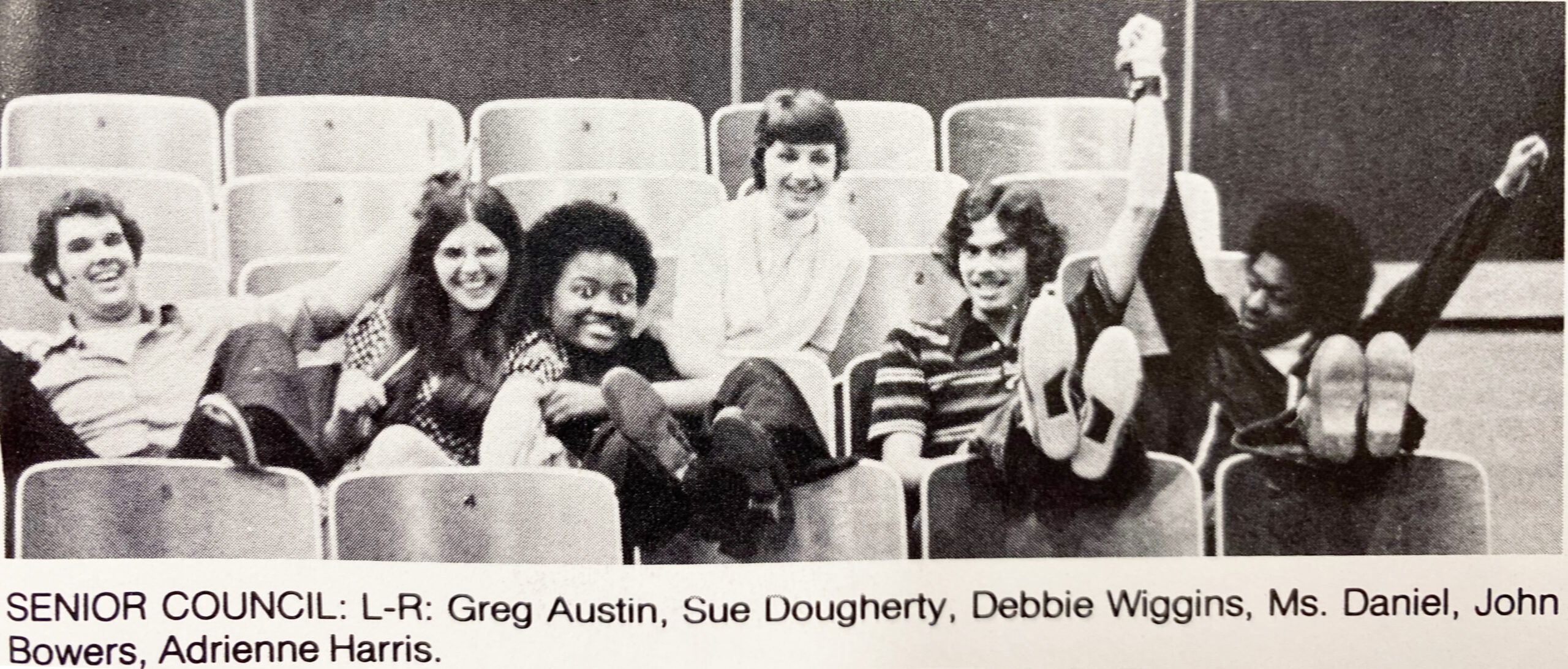
These early yearbook photos from Wilde Lake High School, which opened in 1971, depict an integrated school where white and Black students and teachers appear friendly and comfortable with one another. The Glass Hour, Wilde Lake High School yearbook, 1974.
Courtesy of Columbia MD Archives
Did you take photos with your Brownie Starmite camera–or any other camera–when you were a kid back in the ’60s and ’70s?
Share them with us!
Finding “Our People”
Columbia’s commitment to diversity meant that it lacked the kind of immersive Jewish community found in places like Baltimore. Parents realized that it was up to them to create an environment where their children could explore—and feel comfortable with—their Jewish identity.

This picture is from the Central Maryland News, December 1968. Read the full article and see the names of the kids.
Courtesy of Jewish Federation of Howard County
Learn more about Jewish education in Columbia.
Parents quickly organized an informal Hebrew school, taking advantage of the arrival of native Hebrew-speaker Arie Eisner in 1968, pictured here, with his students. “It was a group of mixed ages, from about eight to eleven years old, and I taught them conversational Hebrew,” Arie recalled. The class met three times a week.
A Jewish youth group for Howard County teens started around 1967, organized by two moms, Edith Rowe and Shirley Auerbach. “We were all in separate schools and our parents wanted us to find each other,” says Jessica Rowe. Joan Tachetti Grauman had a friend who complained that her mother was “dragging” her to a youth group meeting where she wouldn’t know anyone. Joan went along to keep her company and never looked back. “I joined, and it changed my life. Soon, the leaders brought in Fern Eisner to teach us Israeli folk dancing. I loved Fern and I loved dancing. It got me through my teen years.”

Youth group girls dancing at an Israel Independence Day (Yom Ha’atzmaut) celebration, 1970. L-R: Joan Tachetti (Grauman), Susan Auerbach, Jessica Rowe, Gaye Wallace, and their teacher, Fern Eisner.
Courtesy of Jessica Rowe


The Youth Group and Hebrew School are discussed on pages 1 and 2 in this 1970 Jewish Council newsletter.
Courtesy of the Jewish Federation of Howard County
Youth group was also a revelation for Shoshana (Suzanne Pessin) Schnair: “Here are people whose parents have the same values, who had grandparents who maybe spoke with accents. So it was a real feeling of, you found your people.” Susan Auerbach remembers making latkes at the Pessins’ house. “There were a bunch of us,” she recalls. “The kitchen was full.”
Some 18 teens joined the group, which met two or three times a month. In addition to hiking in Patapsco State Park (and falling into the river), the group’s activities in the fall of 1970 included community service, organizing contemporary worship services, and “meaningful discussion of our feelings as Jewish youth.”